
Is an LLC a Corporation? Key Differences, Taxes, and Business Structure Explained
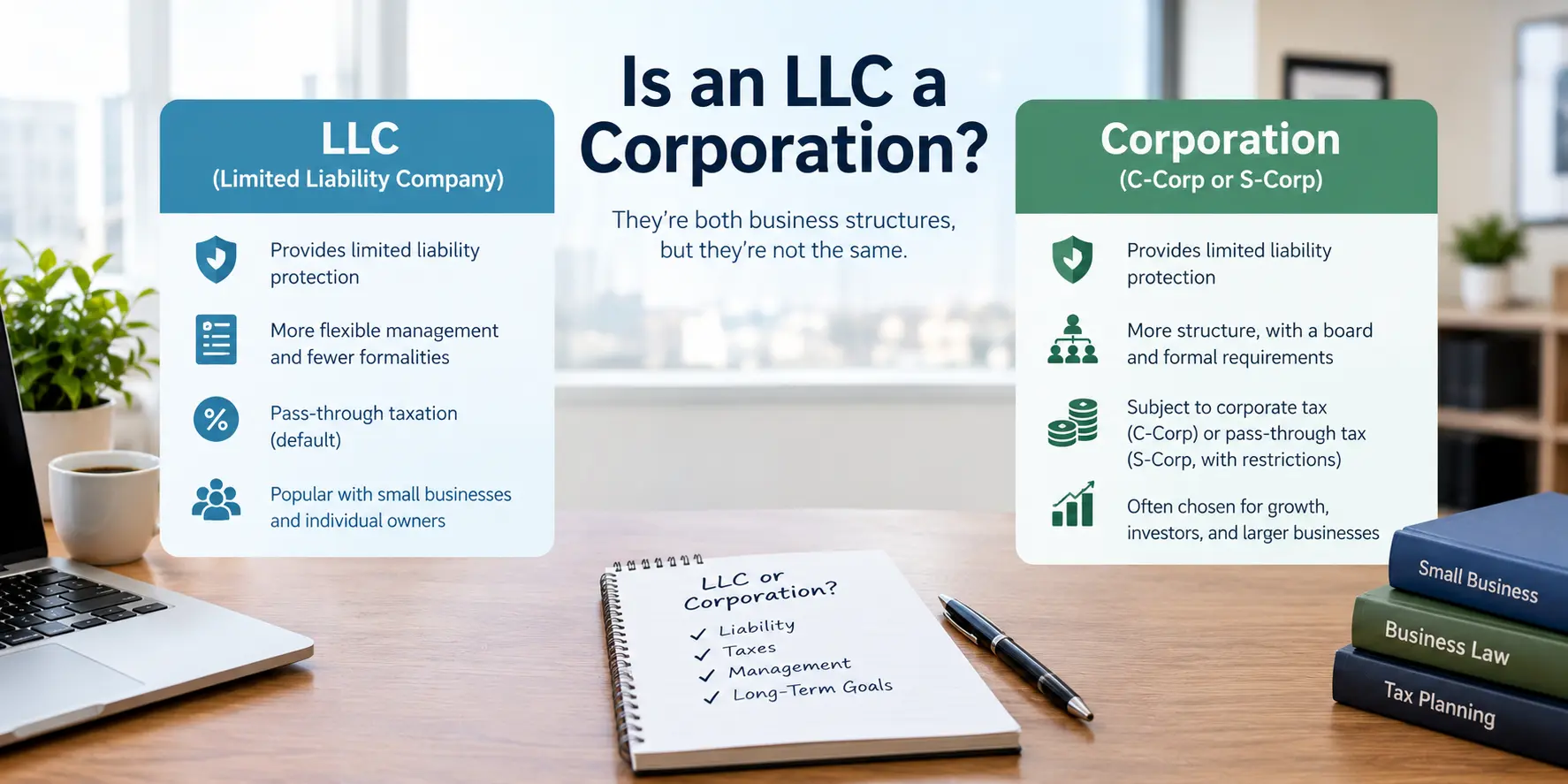
Starting a business involves several decisions, including choosing the right legal structure. One common question entrepreneurs ask is, is an LLC a corporation? The short answer is no. A limited liability company (LLC) and a corporation are separate legal business structures under state law. However, both can protect their owners from personal responsibility for many business debts.
Although these structures share certain features, they differ in ownership, taxation, management, and legal requirements. Understanding those differences helps business owners choose a structure that supports their financial goals and long-term plans.
Is an LLC a Corporation or a Separate Business Entity?
An LLC is not a corporation. Instead, it is a distinct business entity created under state law that combines certain characteristics of corporations and partnerships.
Like a corporation, an LLC generally separates business liabilities from the personal assets of its owners. However, LLCs typically offer more flexibility in management and taxation.
A corporation follows a more formal structure involving shareholders, directors, and officers. Meanwhile, an LLC usually operates through its members or appointed managers.
The main difference between llc and corporation structures involves how the law organizes ownership, governance, and business operations.
Both structures can work well for businesses of different sizes. However, the best choice depends on the company’s needs rather than its industry alone.
What Is an LLC and How Does It Operate?
A limited liability company is a legal business structure formed by registering with the appropriate state authority.
Its owners are called members. Depending on state law, an LLC can have one member or multiple members.
To understand what is an llc and how does it work, consider a small consulting business.
Suppose Sarah launches a marketing agency and registers it as an LLC. Her business can enter contracts, receive payments, and own property separately from her.
If the agency faces ordinary business debts, Sarah’s personal assets generally receive liability protection. However, personal guarantees, fraud, and certain other circumstances can create personal liability.
Member-Managed and Manager-Managed LLCs
LLCs generally use two management structures.
Member-managed LLC: Members participate directly in daily business decisions.
Manager-managed LLC: Members appoint one or more managers to handle operations.
This flexibility makes LLCs attractive to entrepreneurs who prefer straightforward management arrangements.
An operating agreement can also explain ownership percentages, voting rights, profit distributions, and procedures for resolving disagreements.
What Is a Corporation?
A corporation is a legal entity formed under state corporate law. It exists separately from its shareholders and can continue operating even when ownership changes.
Corporations generally have a formal management structure.
Shareholders own the company through shares of stock. Meanwhile, a board of directors oversees major decisions, and officers manage daily operations.
For example, a growing technology company might choose a corporation because it plans to attract outside investors and issue different classes of stock.
Corporations can also provide limited liability protection. However, shareholders may still face personal responsibility in certain situations, including when they personally guarantee business obligations.
Unlike LLCs, corporations generally follow more extensive governance and recordkeeping requirements.
LLC vs Corporation: Understanding the Main Differences
Although both structures create separate legal entities, their operating rules differ considerably.
The following table highlights the most relevant distinctions.
| Feature | LLC | Corporation |
|---|---|---|
| Owners | Members | Shareholders |
| Ownership interests | Membership interests | Shares of stock |
| Management | Members or managers | Directors and officers |
| Liability protection | Generally available | Generally available |
| Default federal taxation | Disregarded entity or partnership | C corporation |
| Tax flexibility | May elect corporate taxation | May qualify for S corporation taxation |
| Formal requirements | Usually fewer | Generally more |
| Profit distribution | Flexible, subject to applicable rules | Based on corporate and stock rights |
| Investor suitability | Depends on ownership arrangements | Often preferred for equity investment |
| Business continuity | Depends partly on state law and agreements | Generally continues despite ownership changes |
The corporation advantages and disadvantages become particularly relevant when a business expects rapid expansion, institutional investment, or complex ownership arrangements.
However, businesses should evaluate more than administrative convenience when comparing these structures.
Ownership and Decision-Making
LLC members can establish flexible voting and management arrangements through an operating agreement, subject to state law.
Corporations, by comparison, generally operate through directors and officers with responsibilities defined by corporate law and governing documents.
Consequently, corporations may provide a more standardized framework for businesses with numerous investors.
Administrative Responsibilities
Corporations commonly maintain corporate records, hold required meetings, and follow formal governance procedures.
LLCs generally face fewer internal formalities. Nevertheless, they must still comply with state filing, licensing, tax, and reporting requirements.
Requirements vary by jurisdiction, so business owners should check their state’s rules.
Is an LLC a Corporation for Tax Purposes?
An LLC is not automatically treated as a corporation for federal income tax purposes. However, it can elect corporate tax treatment.
The Internal Revenue Service generally classifies LLCs according to their ownership and tax elections.
Single-Member LLC Taxation
By default, the IRS generally treats a single-member LLC as a disregarded entity for federal income tax purposes.
Therefore, the owner usually reports business income on the appropriate personal tax return schedule.
However, the LLC remains a separate legal entity under applicable state law.
Multi-Member LLC Taxation
A domestic LLC with multiple members generally receives partnership tax treatment unless it elects otherwise.
Typically, the LLC files an informational partnership return, while members report their allocated income on individual returns.
Corporate Tax Elections
An eligible LLC can elect taxation as a C corporation. It may also qualify to elect S corporation tax treatment.
These elections affect federal taxation without necessarily changing the LLC’s legal structure.
The difference between llc and s corp arrangements often creates confusion because an S corporation is a federal tax classification, not a separate type of state-law business entity.
For authoritative guidance, business owners can review the IRS Limited Liability Company information.
Is an LLC a Corporation or Partnership?
Another common question is, is an llc a corporation or partnership?
Legally, an LLC is neither. It is a separate business structure recognized under state law.
However, federal tax rules may treat an LLC as a partnership or corporation.
For example, two entrepreneurs might establish an LLC and share ownership equally.
By default, their domestic multi-member LLC generally receives partnership tax treatment. Nevertheless, the company remains an LLC under state law.
This distinction matters because legal structure and tax classification serve different purposes.
Legal structure determines organizational rules and liability protections. Meanwhile, tax classification determines how the IRS treats business income.
Benefits of Choosing an LLC
Many small businesses prefer LLCs because they offer a practical balance between legal protection and operational flexibility.
Some notable benefits of an llc include:
- Personal liability protection: Members generally receive protection against ordinary business debts.
- Flexible management: Owners can manage operations themselves or appoint managers.
- Tax options: Eligible LLCs can choose from different federal tax classifications.
- Simpler administration: LLCs often require fewer corporate formalities.
- Flexible ownership: Operating agreements can establish customized ownership and distribution arrangements.
For instance, a family-owned retail business may benefit from an LLC because its owners want liability protection without establishing a traditional corporate board.
However, LLCs still involve filing fees, ongoing compliance responsibilities, and possible state-level taxes.
When Does a Corporation Make More Sense?
Corporations may offer advantages when businesses plan to raise significant investment capital or establish complex ownership structures.
For example, venture capital investors often prefer C corporations because corporate shares provide a familiar investment framework.
Corporations may also support employee stock option programs and multiple classes of equity.
As a result, businesses pursuing rapid expansion sometimes find corporate structures more suitable.
However, traditional C corporations can face double taxation.
First, the corporation pays federal income tax on taxable profits. Then, shareholders may pay taxes on dividends they receive.
Eligible S corporations generally use pass-through federal income taxation instead, although qualification and distribution rules apply.
Therefore, entrepreneurs should compare expected investment needs, tax consequences, and management requirements before incorporating.
Common Mistakes When Comparing LLCs and Corporations
Choosing a business structure without understanding its responsibilities can create unnecessary expenses and complications.
Assuming Liability Protection Is Absolute
Neither structure guarantees complete personal protection.
For example, owners may remain responsible for personally guaranteed loans, their own wrongful actions, or certain tax obligations.
Therefore, maintaining appropriate insurance and separating personal and business finances remains essential.
Confusing Legal Structure With Tax Status
An LLC that elects corporate taxation does not automatically become a corporation under state law.
Similarly, an S corporation election concerns federal taxation rather than creating a new state-law entity.
Ignoring State Requirements
Formation fees, annual reports, franchise taxes, and compliance obligations vary by state.
Consequently, entrepreneurs should research their jurisdiction before registering.
Is a Nonprofit a Corporation or an LLC?
People establishing charitable organizations sometimes ask, is a non profit a corporation or an llc?
Many nonprofit organizations form as nonprofit corporations under state law.
However, nonprofit LLCs may be possible under certain state laws and circumstances.
Importantly, nonprofit status under state law does not automatically provide federal tax exemption.
Organizations generally must satisfy applicable IRS requirements to qualify for tax-exempt treatment.
For example, a charitable organization seeking recognition under Section 501(c)(3) must meet specific organizational and operational standards.
Therefore, founders should distinguish nonprofit incorporation from federal tax-exempt recognition.
How to Choose the Right Business Structure
The best structure depends on ownership arrangements, financial expectations, and future business goals.
Before registering, consider the following steps.
1. Identify Your Ownership Plans
Determine whether the business will have one owner, several partners, or outside investors.
An LLC may suit a small ownership group, while a corporation may better support complex equity arrangements.
2. Compare Tax Consequences
Review how each structure affects income taxes, employment taxes, and potential distributions.
Because tax outcomes depend on individual circumstances, consulting a qualified tax professional can help prevent expensive mistakes.
3. Evaluate Management Preferences
Consider how much administrative structure your business needs.
For example, an owner-operated service business may prefer flexible LLC management.
Meanwhile, a company preparing for institutional investment may benefit from corporate governance.
4. Review Long-Term Growth Goals
Think about future funding, ownership transfers, employee equity, and expansion.
Choosing a suitable structure early can reduce the need for complicated changes later.
Frequently Asked Questions
Is an LLC Considered a Corporation?
No. If someone asks, is an llc considered a corporation, the legal answer is generally no. An LLC is a distinct state-law entity, although it may elect corporate treatment for federal income taxes.
Can an LLC Become a Corporation?
Yes. Depending on state law, an LLC may convert into a corporation through an authorized conversion or restructuring process.
However, changing tax classification alone does not necessarily change its legal entity type.
What Is the Difference Between an LLC and a Corporation?
For entrepreneurs asking what is the difference between an llc and a corporation, the main distinctions involve ownership, management, governance requirements, and default taxation.
Both generally provide limited liability protection, but corporations use a more standardized shareholder and director structure.
Is an LLC Better Than a Corporation?
Neither structure is automatically better.
An LLC often suits smaller businesses seeking management flexibility. In contrast, a corporation may better support outside investment and complex equity ownership.
Making the Right Choice for Your Business
Choosing between an LLC and a corporation requires more than comparing registration costs.
Start by reviewing your ownership plans, expected profits, financing needs, and preferred management style. Then, examine state compliance rules and potential tax consequences.
For many small businesses, an LLC provides a useful combination of flexibility and liability protection. However, corporations may offer stronger advantages when companies seek substantial equity investment.
Before making a final decision, consult a qualified business attorney or tax professional who understands your state’s requirements.
A well-chosen legal structure can support smoother operations, clearer ownership arrangements, and more sustainable business growth.